On the global chessboard of Haute Couture — where luxury is increasingly measured in capitalizations and market shares — the House of Julien Fournié stands as one of the most singular and avant-garde voices of the 21st century. At the crossroads of exceptional craftsmanship, technological innovation, and a deliberate philosophy of differentiation, this independent and sovereign maison has forged its own Haute Couture trajectory since 2009.
At the heart of this journey lies an uncommon alliance: Julien Fournié, the couturier-architect, and Jean-Paul Cauvin, the intuitive strategist whose analytical and literary mind shapes the house’s intellectual framework.
The Roots of a Universal Creator
Nothing predestined this child from the northern suburbs of Paris — born to a French father and a Castilian mother — to become one of the planet’s last fifteen Grand Couturiers. He grew up surrounded by noble materials and form, inheriting tactile sensitivity from grandparents who were a tanner and a corset-maker, alongside a passion for drawing that would illuminate his entire oeuvre.
Before couture, however, came science: two years of medical studies and a degree in biology. This anatomical rigor became his signature. In Fournié’s universe, garments are not decorative objects; they are living architectures traveling toward their destiny.
His mastery emerged through total immersion among the last giants of couture. He trained with those he affectionately calls his “fathers”: John Galliano at the House of Dior, Alexander McQueen at the House of Givenchy, and later Jean Paul Gaultier, who welcomed him as a Haute Couture assistant designer, transmitting the ultimate disciplines of cut, structure, embroidery, and material.
Yet it was his meteoric appointment as artistic director of the House of Torrente at only 28 that sealed his encounter with his strategic alter ego.
This exceptional journey has revealed something obvious to Julien Fournié:
“Before healing bodies, we must heal minds.”
Couture ceases to be something one wears. It becomes an act of inner reconstruction.
Jean-Paul Cauvin: Philosopher, Interpreter, Strategist of Fashion
Alongside technical heritage stands the intellectual and strategic dimension brought by Jean-Paul Cauvin. His background is remarkably unconventional, shaped by deep literary, linguistic, and philosophical culture.
Writer, monk, actor, seasoned journalist (formerly with Pure Trends and Fashion Daily News), and for several years head of marketing at France 2 television, he possesses a rare understanding of imagery, narrative construction, and audience dynamics.
His entry into fashion occurred through talent management, notably as the agent of supermodel Laetitia Casta during her transition into cinema. These experiences granted him a strategic reading of public trajectories and collective psychology.
Cauvin approaches fashion as language. He articulates artistic vision, ethical positioning, and economic independence. While many designers dissolve into multinational conglomerates, this duo has built a free house — a maison conceived as a work of art.
The House of Julien Fournié
In 2009, Fournié founded his own house in Paris, determined to preserve absolute creative freedom. From the outset, the approach was atypical: an agile structure centered on exclusive Haute Couture rather than volume-driven commercial strategies.
Recognition came quickly. The house received the Grand Prix de la Création de la Ville de Paris (2010) and was admitted to the official Haute Couture calendar as a guest member (2011). In 2017, it obtained the coveted Haute Couture designation — a state-protected title granted to only a handful of actors worldwide.
Since achieving this “Holy Grail,” which opened doors to Qatari palaces and the court of Sheikha Moza, the maison has continued to innovate. A pioneer in digital processes, Fournié dematerialized his ateliers as early as 2010 through the FashionLab partnership with Dassault Systèmes.
The technological apotheosis came in 2017, during a three-hour surprise visit from Tim Cook to his atelier. Impressed by the couturier’s mastery of digital drawing on iPad Pro, the Apple CEO named him a global ambassador.
Today, the House of Fournié does not merely create gowns; it codes the luxury of tomorrow — from the metaverse to collaborations with Tencent Games on PUBG Mobile.
“First Misfits”: An Ode to the Unadapted
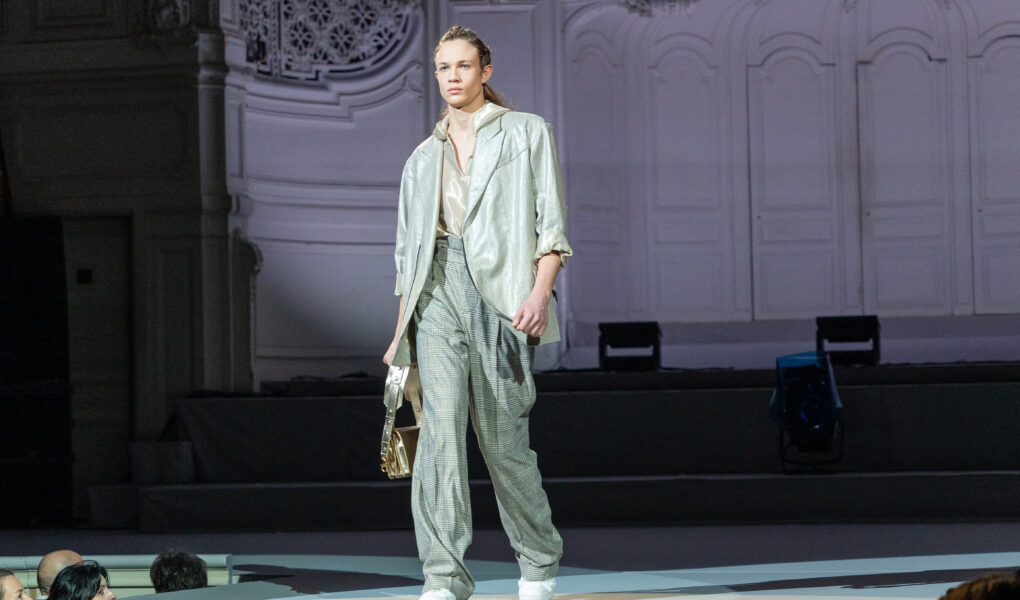
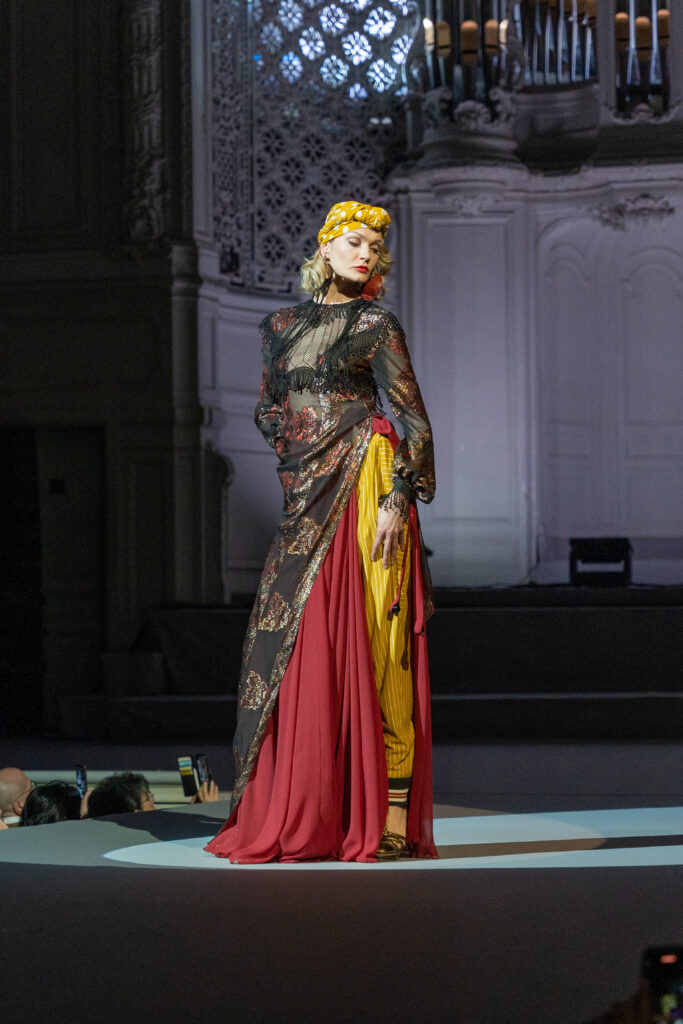
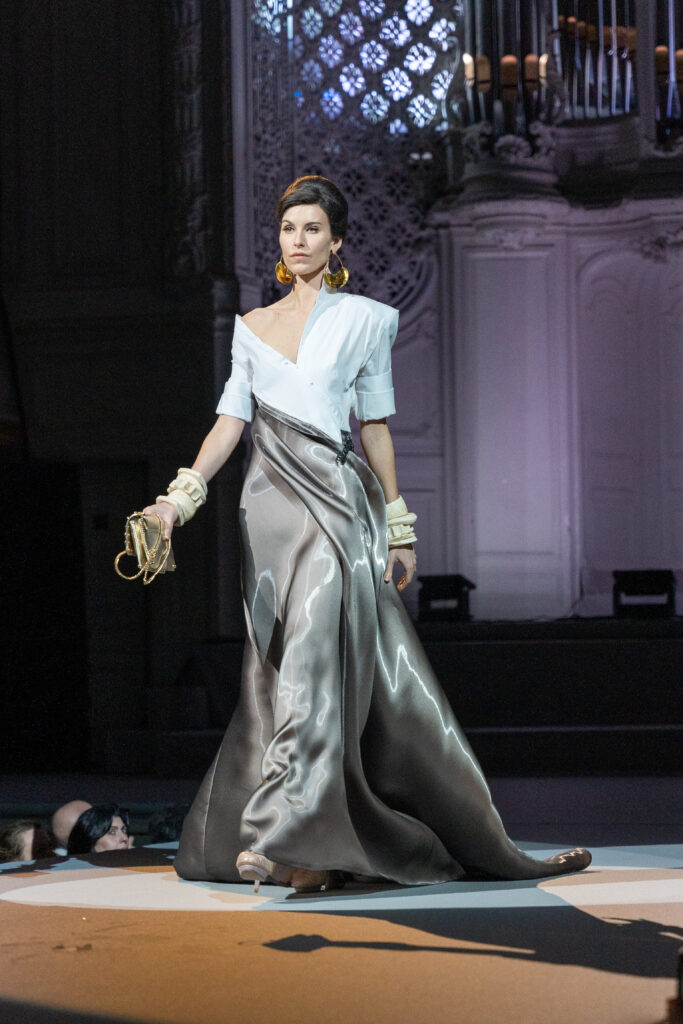
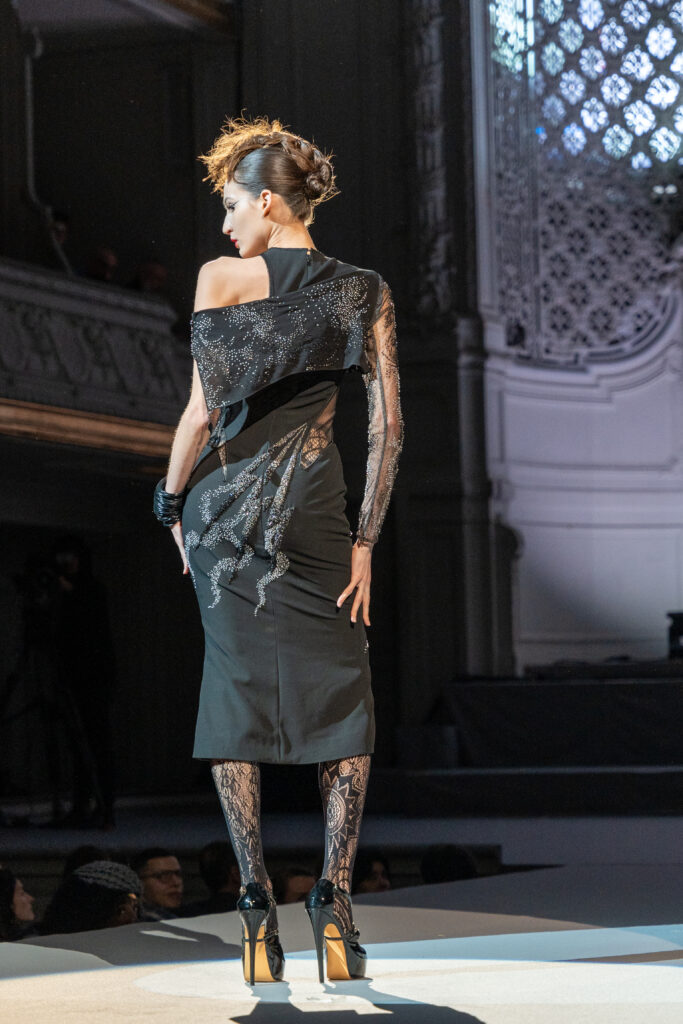
The January 2026 show at Salle Gaveau marked a decisive rupture with politically sanitized fashion narratives. Titled First Misfits, the collection celebrated the unadapted, the non-conforming, the singular — legends in the making.
It resonates with a deeper truth: history’s greatest transformations almost always emerge from those who do not fit the existing world.
A perfectly adapted individual has no reason to transform a system. Marginal figures, by contrast, perceive its limits. They see what others cannot see. They suffer from imposed norms and seek alternative paths. They become, naturally, agents of rupture.
Nearly every transformative figure in history was once considered marginal — misunderstood artists, rejected scientists, dangerous thinkers, unconventional creators. To create something new is to step outside the collective frame.
In other words: Maladaptation is often the precursor of collective mutation.
Haute Couture remains one of the rare domains where singularity, difference, and identity are celebrated. Honoring non-conformity in a collection is not merely an aesthetic gesture; it embodies a tangible philosophical proposition:
Marginal individuals are not anomalies of society. They are the scouts of the future.
From this collection emerges a fundamental question: What kind of humanity do we want to become?
One of the implicit answers offered by the Eighth Art is that the transformation of the world must strive towards a civilization where creation, consciousness, and beauty become the keystone of human evolution. In this way, humanity could be transfigured into the image of the universe itself: infinite, eternal, and majestic.
Conclusion: Haute Couture as the Eighth Major Art
Beyond the dream, a reality remains: as the luxury sector concentrates into fewer and fewer hands, Julien Fournié and Jean-Paul Cauvin maintain the course of total independence.
“Being a Grand Couturier is nothing like a fairy tale,” Fournié recently confided during fittings. It is a daily struggle for uniqueness, for the piece that resembles no other, for the client who becomes the creator of her own myth.
The House of Julien Fournié is not a relic of the past, but the prototype of a possible future emerging from the old world. It demonstrates that tradition — when augmented by technology and protected by fierce independence — remains one of the most powerful major arts.
By restoring power to the individual in an era of dissolving identities, Fournié and Cauvin remind us of an essential truth: while conformity reassures, it is difference that creates legends.
At Salle Gaveau, the message was unmistakable:
Find your legend.
CHIKH Larbi
Photographies : © CHIKH Larbi – Salle Gaveau Paris, 27 janvier 2026
@ammanembroideries
IMPRESSIVE EMBROIDERED CORSET AND SKIRT
GRAFFITI AND TAGS @catchmysillage embroidery
@nicolasdegennes @fannymart3010 makeup.
@nevillehairandbeautyofficial @elenalavagni
@iamdomenicocasella hair. @jeanpaulcauvin casting.
@napoleonstudio_ prod. @lola_cstn @clementtzaut
@jus.tinegrgs @johff_ @g_lools
PR: @lappartpr @delphinefashion